
Garcia 1999
Dramatic story of a returnee from Argentina who tries to find answers to the unfortunate events from the past.
Dramatic story of a returnee from Argentina who tries to find answers to the unfortunate events from the past.
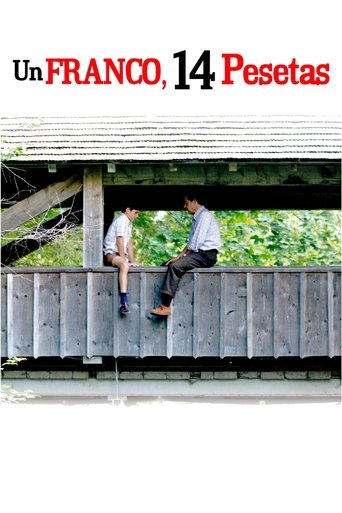
In 1960, Martín and Marcos are forced by their difficult personal circumstances to travel to Switzerland in search of work, leaving their families in the Madrid of Franco's Spain. But they undertake more than a simple journey; they begin the road to a new life.

The story is set at the beginning of the 20th century in Sicily. Salvatore, a very poor farmer, and a widower, decides to emigrate to the US with all his family, including his old mother. Before they embark, they meet Lucy. She is supposed to be a British lady and wants to come back to the States. Lucy, or Luce as Salvatore calls her, for unknown reasons wants to marry someone before to arrive to Ellis Island in New York. Salvatore accepts the proposal. Once they arrive in Ellis Island they spend the quarantine period trying to pass the examinations to be admitted to the States. Tests are not so simple for poor farmers coming from Sicily. Their destiny is in the hands of the custom officers.

Indira, a Cuban immigrant, succeds to flee to United States, but her emigration has consequences inflicted to her family. In Sanata Claram in Cuba, she left her 11-years-old son, mother and family. In New Jersey, Indira struggles to adapt to weather, different mentality and to a completely new social system.

An inventor spurns his city life and moves his family into the jungles of Central America to make a utopia.

When an Italian man comes out of the closet, it affects both his life and his crazy family.

Sweden, 1849. A poverty-stricken family decides to move to America in the hope of finding a better and more prosperous life. Although they know the journey will be dangerous and the pressure of facing a new life in a strange and wild land is great, they are determined to succeed.

After his plane crashes in Siberia, a Russian dancer, who defected to the West, is held prisoner in the Soviet Union. The KGB keeps him under watch and tries to convince him to become a dancer for the Kirov Academy of Ballet again. Determined to escape, he befriends a black American expatriate and his pregnant Russian wife, who agree to help him escape to the American Embassy.

After growing up poor in Salmonella, Vincenzo Cortino installs himself as the preeminent, if bumbling, Mafia don of the New World. But now he must pass on power to one of his two sons: either level-headed veteran Anthony or vituperative loose cannon Joey.

Paul and Agnes have been going out for quite a while and Agnes is shocked to learn that he'd rather live with two roommates on campus than move in with her. As soon as he meets one of his roommates, Louis-Anault, Paul's behavior changes - he is attracted to Louis without realizing so himself. Agnes, on the other hand, gets quite jealous and offers a bet: Whoever gets to have Louis-Anault first, wins... If she does, Paul will no longer explore his homosexual desires, if he does - she'll walk away. Meanwhile, Paul meets Mecir, a young Arab worker, who shows him there's more to life than elite colleges...

Three intertwined stories about Serbian truck driver who is involved into drug trafficking without knowing, Czech family who live by the road which makes them a lot of troubles since many cars crash into their house, and a bus full of Swedish grannies who go on a Trans-European package holiday.

Bruno Stroszek is released from prison and warned to stop drinking. He has few skills and fewer expectations: with a glockenspiel and an accordion, he ekes out a living as a street musician. He befriends Eva, a prostitute down on her luck and they join his neighbor, Scheitz, an elderly eccentric, when he leaves Germany to live in Wisconsin.
One night, the phone rings in a traditional Portuguese snack bar from the country side. The Spanish Civil Guard is looking for Kunta. He isn't there and till he arrives people speculate about those phone calls and about who is that man. His he a thief? A terrorist?
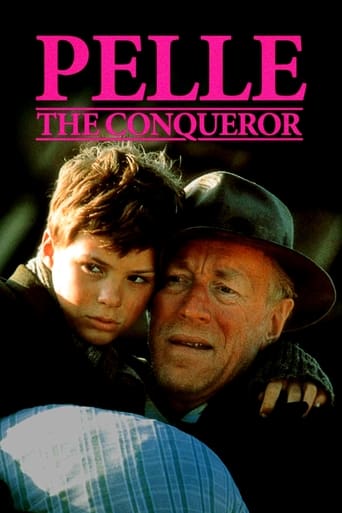
In the late 19th century, two Swedish emigrants, Lasse Karlsson and his son Pelle, arrive on the Danish island of Bornholm hoping to find work on a farm and save enough money to travel to the United States of America.

The siblings Bebe and Mikhail leave their country of Moldova to apply for asylum in Germany. Their flight turns into a modern odyssey.

A short, cautionary tale of emigrating to America.

A Jewish woman named Jettel Redlich flees Nazi Germany with her daughter Regina, to join her husband, Walter, on a farm in Kenya. At first, Jettel refuses to adjust to her new circumstances, bringing with her a set of china dishes and an evening gown. While Regina adapts readily to this new world, forming a strong bond with her father's cook, an African named Owuor.

Two young Spanish men, with a university education, are tired of unemployment and decide to move to Germany. But soon they will find out that finding a better living is not as easy as they expected.
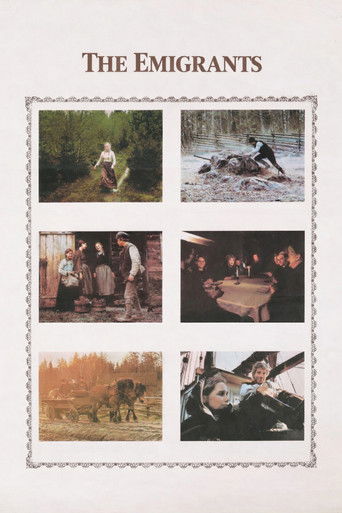
Karl and Kristina Nilsson work on a farm in a cold and desolate area of 19th century rural Sweden. Growing privations, combined with increasing social and religious persecution, motivate the Nilssons and many of their neighbors to strike out for the United States. Following a treacherous ocean crossing and an equally grueling land passage, the emigrants find themselves in seemingly idyllic Minnesota.

In the beautiful area of Paris, Maria and José Ribeiro lived for almost thirty years on the ground floor of a Haussmann building, in their dear little lodge.

It's the story of two slightly crazy guys who are forced to leave their town, where the annual Gooseberry Days celebration is the biggest attraction, and go to London for work. To say, however, that the tour doesn't go according to plan would be a very mild description of what happens next. The protagonists get separated at the very beginning as a result of a gnarled party. The journey that follows is woven with a plethora of marvelous characters. The viewer will find among them: truckers, gypsy camper traders, anarchist squatters, recidivists hiding from the Polish justice system or go-go club employees.
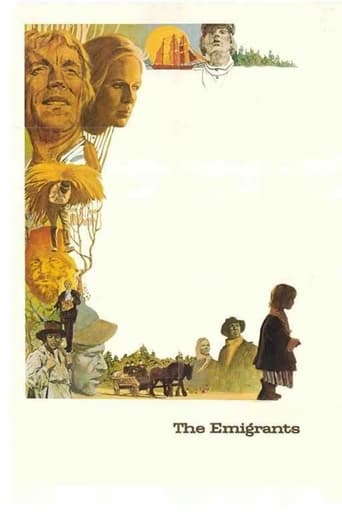
Karl and Kristina Nilsson work on a farm in a cold and desolate area of 19th century rural Sweden. Growing privations, combined with increasing social and religious persecution, motivate the Nilssons and many of their neighbors to strike out for the United States. Following a treacherous ocean crossing and an equally grueling land passage, the emigrants find themselves in seemingly idyllic Minnesota.
